A kit for independent testing of the cylinder head gasket and the cylinder head itself in combustion vehicles.
- Saves time and money - you can perform the test on your own without having to visit a car mechanic.
- For different combustion engines with liquid cooling - this tester will work for cars fuelled by gasoline, diesel oil and LPG.
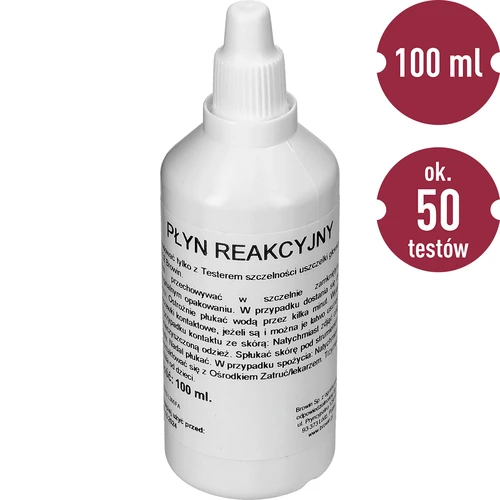
- 100 ml of CO2 reaction liquid - this large volume of liquid is sufficient for performing about 50 tests.
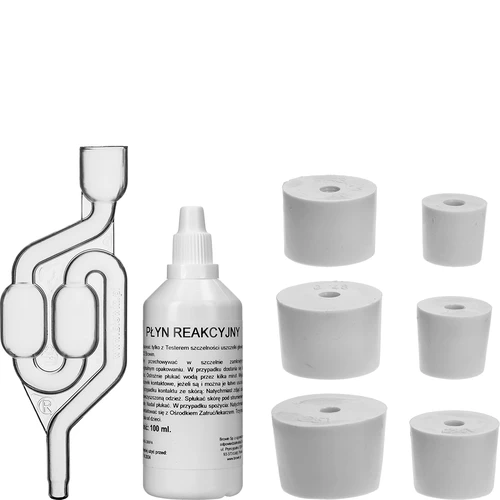
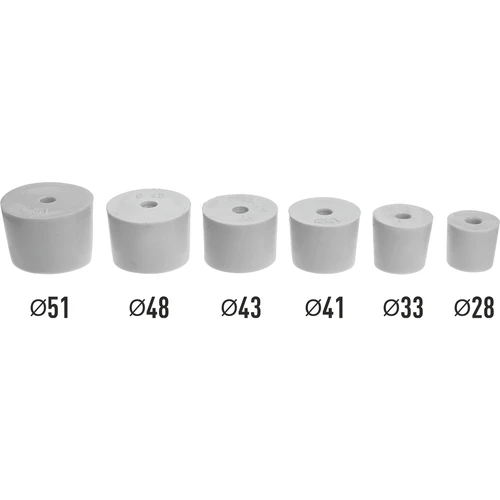
- Comes in a kit with 6 adapters - you will receive a kit with adapters having the following diameters: 28, 33, 41, 43, 48 and 51 mm.
- Simple to use - the tester features a manual that will make sure you will test the gasket on your own without any problems.
Do you suspect that the gasket under the cylinder head in your engine is damaged? Before you hand your car over to a mechanic, check the tightness of the cylinder head gasket yourself. Thanks to the CO2 cylinder head gasket tester you will learn whether it is necessary to replace that gasket.
You can use the tester for vehicle fuelled by gasoline, diesel oil or LPG.
Thanks to as much as 100 ml of CO2 reaction liquid included in the kit, you can perform about 50 tightness tests.
It is not important what the expansion tank or cooler opening diameter is in your engine, as the adapters included in the kit are suitable for inlet diameter from 28 to 51 mm.
This cylinder head gasket tester is a piece of equipment that is easy to use and allows simple confirmation or elimination of a cylinder head gasket fault or cylinder head fault.
The kit includes:
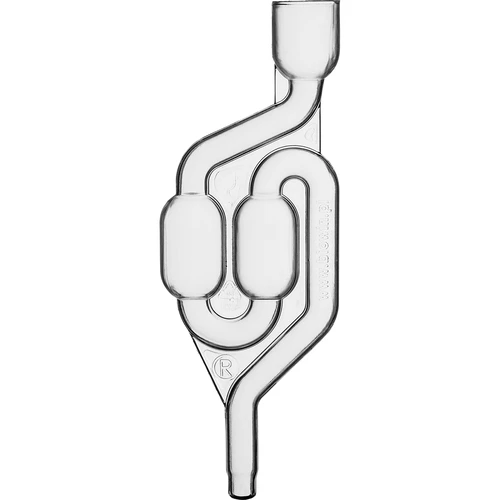
- a shatterproof tube
- 100 ml of reaction liquid (for about 50 tests)
- 6 adapters: ø 28, 33, 41, 43, 48 and 51 mm
- user manual
How to use:
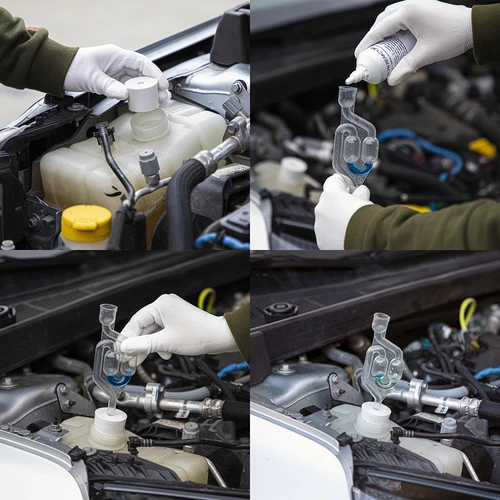
- Pour the reaction liquid (2 ml) into the test tube so that the liquid level reaches below the bubbles.
- Put a fitting adapter into the cooler inlet (the engine should be warm and operating on slightly elevated speed, on idle run).
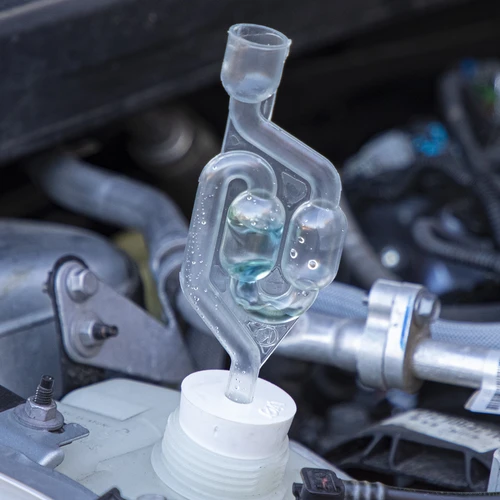
- Put the tester with a reaction liquid into the plug.
- Watch the reaction liquid bubble. If the reaction liquid becomes yellow or green, this indicates that the cylinder head gasket or the cylinder head itself is damaged.
- After the test is finished, wash the tube with water and dry it.
Please note!
Remain particularly cautions when unscrewing the cooler inlet plug. There is a risk of burning.
Do not allow for the cooling liquid to become mixed with the reaction liquid. An inconclusive discolouration may occur.
The engine will be operating while the test is performed. Secure the vehicle against accidental movement by activating a hand brake, blocking all wheels and limiting access to the gear lever.
Do not allow any persons not participating in the test near the vehicle (especially children).
Eliminate and loose elements of outer clothing or make sure they remain close to the body. Otherwise, there is a risk of those elements being pulled in by rotating parts of the engine, which may lead to injury.
Use gloves, protective eyewear and clothing protecting against burns.
Adhere to the principles of occupational health and safety.




 Cheese calculator



 Winemaking








![Cylinder head gasket tester - 6 adapters, 100 ml of liquid ['tightness test', ' gasket tightness test', ' cylinder head gasket tester', ' CO reaction liquid 100 ml', ' gasket tester adapters', ' gasket tester 50 tests', ' cylinder head gasket']](/static/images/100/cylinder-head-gasket-tester-6-adapters-100-ml-of-liquid-290500.webp)