How to make cheese? - A step-by-step guide
Fresh, white cheese is a staple in every Polish home. Unfortunately, many products on store shelves contain unnecessary ingredients that increase yield or artificially improve texture. A good-quality fresh, white cheese should contain only milk, calcium chloride, and rennet. If it is an acid-set cheese, it should also include lactic fermentation cultures, or citric or lactic acid.
Notes
Is homemade production complicated, labor-intensive, or expensive? Absolutely not! To make the simplest Koryciński-type cheese, we need:
- Pasteurized milk (min. 3.2% fat) or raw milk straight from the cow
- Calcium chloride
- Rennet
- Seasonings to taste.
The choice of milk is very important. You won't get a good cheese if the raw material is of poor quality. The best solution is to use milk straight from the cow that has not undergone industrial processing. If that’s not possible, use store-bought milk pasteurized at a low temperature (up to 74 °C). Casein, the protein that is the main component of cheese, retains its bioavailability in such a milk preservation (heat treatment) process. UHT milk is sterilized—heated for a few seconds at 121 °C. Casein then changes its spatial structure, and rennet coagulation will not be possible. Pasteurized milk can be found in the store refrigerator. It has a shorter shelf life compared to UHT milk, so plan your cheesemaking in advance. The higher the fat content of the milk, the tastier the cheese will be. Fat is a carrier of flavor and contains fat-soluble vitamins such as A, D, E, and K. The right fat content (3–5%) ensures proper cheese moisture. Too little fat will result in a dry, grainy, crumbly cheese, while too much will yield a wet cheese.
Adding calcium chloride is essential when making rennet-set cheeses. Calcium ions support the action of the enzyme—rennet. Adding calcium chloride to store-bought pasteurized milk is necessary. In the case of milk straight from the cow, the required amount depends on several factors, primarily the season. In summer and early autumn, milk yield increases, which may be due to improved feeding of cows. As a consequence, the amount of protein and fat per unit of milk decreases, as does calcium. The amount of calcium chloride determines the quality of the curd. An appropriate dose is 2–3 g per 10 L of milk. Too little will reduce yield, and too much leads to a dry, hard curd.
Rennet is an enzyme, and its activity depends on temperature, pH, the presence of metal ions, and more. Rennet shows maximum activity at 38 °C—this is the temperature to which the milk should be heated before adding the rennet.
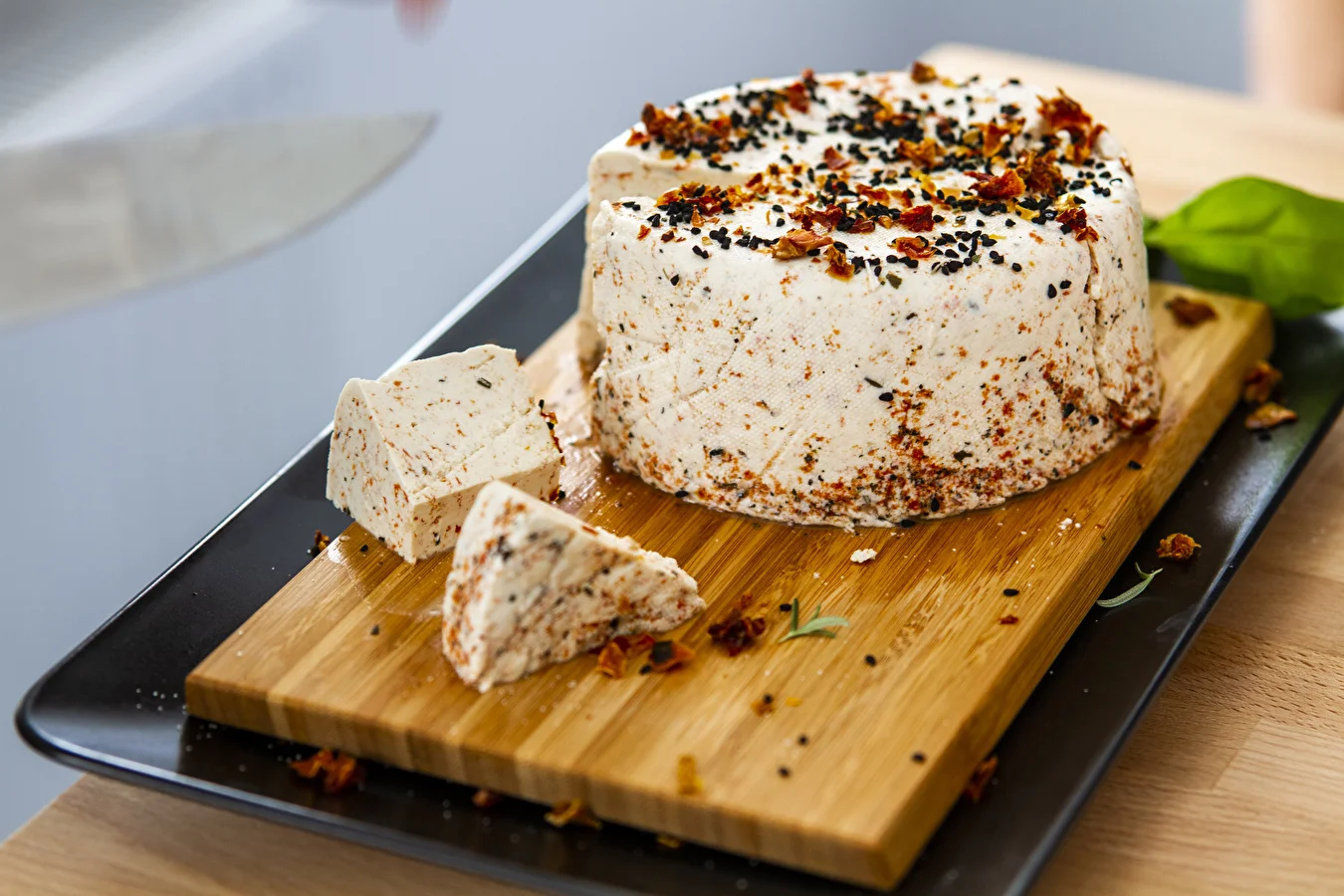
To make Koryciński-type cheese, heat the milk and add the appropriate amount of calcium chloride during heating. Once the milk reaches 38 °C, add the proper amount of rennet diluted in a small amount of lukewarm water. Do not dilute rennet in the warming milk itself, because the enzyme will immediately coagulate the protein and you’ll get a curd that you won’t be able to disperse in the milk. The order matters. Add calcium chloride first. If you reversed the order, the chloride would not distribute throughout the entire volume of milk because the rennet would start forming a curd. Cover the pot with aluminum foil and maintain the temperature at 38°C. After about 40 minutes, check whether the curd is ready. To do this, swirl the pot with quick movements. If the curd pulls away from the sides of the vessel without tearing, it is ready. Next, cut the curd into cubes about 1 x 1 cm and set aside for a dozen or so minutes to allow more whey to expel. After this time, you can repeat the process, this time cutting the curd diagonally. The easiest way to remove whey from the pot is to place a sieve in it. Whey will collect inside and can be easily removed, e.g., with a ladle. Some whey will still remain in the pot. Transfer everything into a cheesemaking cloth, e.g., a wedge-type cheesecloth. You can hang the cloth for a dozen or so minutes or gently press the curd in the cloth. The next step is to place the curd in batches into a cheese mold and add any extras between the layers, such as pepper, oregano, basil, dried tomatoes; you can also add nuts or dried fruit. To make the cheese salty, you can use several methods:
- add salt directly to the milk—the amount should be fairly high, as a significant portion of the salt will be lost with the whey
- add salt to the layers placed in the cheese mold
- make a brine and keep the cheese in it for 1–2 days. In this case, press the cheese well in a cheese press; otherwise, it would fall apart.
Put the cheese in the refrigerator and, after a few hours, turn it over to the other side (if it has been pressed in a cheese press, this is not necessary). It’s worth flipping the cheese several times at roughly two-hour intervals. The cheese tastes best the next day.
Making homemade cheese is simple and enjoyable. Cheese you make yourself contains no questionable food additives. You can easily modify its flavor by choosing different add-ins. Homemade production can quickly turn into a passion, and sharing your products with loved ones brings great joy. …because homemade is better.
A video that will teach you step by step how to make cheese: HERE